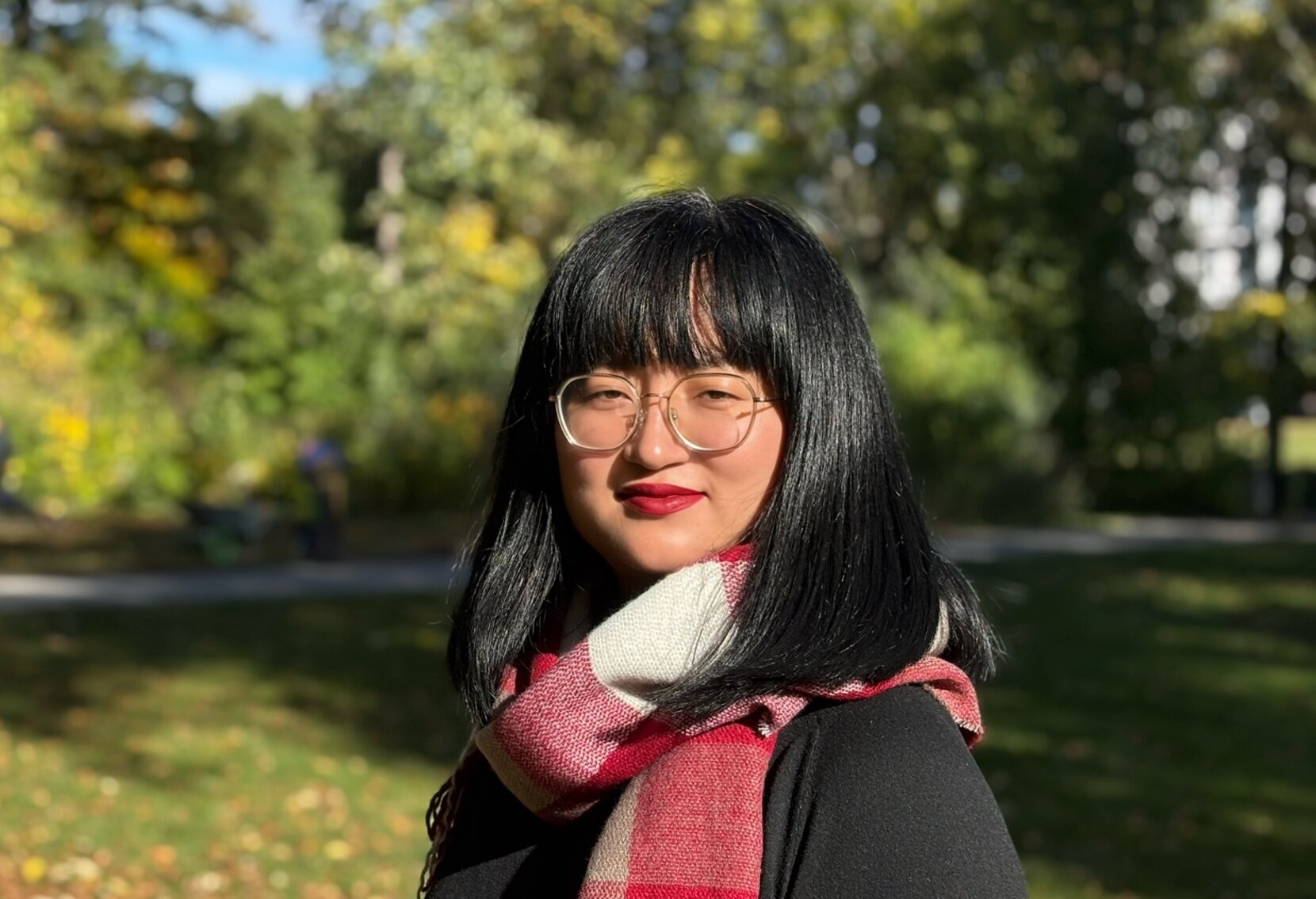
Can our bodies change how artificial intelligence sees the world? That is the question explored by artist and researcher Dr. Chang Gao. An associated researcher at Freie Universität Berlin’s Collaborative Research Centre “Intervening Arts” and a lecturer at the Berlin University of the Arts (UdK), she works at the intersection of contemporary art, embodied AI and affective technologies.
“What interests me is how artificial intelligence absorbs human ideas of normality, identity and desire—and reproduces the cultural biases and social power relations that come with them,” Gao explains. Generative AI is trained on human-produced texts and images that reflect particular ways of understanding the world. “It can also reproduce the cultural assumptions, hierarchies and exclusions embedded in them.”
In her project SensoryHybrid³, she is looking for another way to engage with these systems: not solely through language and predefined categories, but also through bodily perception and physiological feedback. “I’m fascinated by whether our bodies can change how AI perceives and represents the world.” In her artistic experiments, she works with heart activity, touch, movement and audiovisual environments that respond to the people in them. Combining sculpture, sensing and performance, she explores “what happens when touch, movement and bodily signals encounter technologies shaped by language and inherited cultural norms.” Her aim is not only to make biases in AI systems visible. She also investigates whether, and under what conditions, such encounters could go beyond temporarily changing AI-generated output and influence the underlying patterns of representation over time.
She also remains critical of her own methods. “At the same time, I know that physiological signals do not directly reveal our emotions or desires. The technological interpretation of those signals must also be questioned.” For Gao, the body is not simply another source of data, but a starting point for asking what counts as knowledge and who gets to decide. Her central research question is therefore whether embodied, affective interactions can open up new forms of knowledge and relationships between humans and AI.
I’m fascinated by whether our bodies can change how AI perceives and represents the world.
“My path into this field began not in computer science but in art,” says Gao. She first asked who public space is for and who gets to decide which bodies and images are allowed to be visible there. In China, she pursued artistic research and directed the Social Innovation Research Lab at the Central Academy of Fine Arts in Beijing. She subsequently completed a PhD at the Royal College of Art in London, exploring how eroticism and sensual imagery can challenge censorship and cultural power, particularly in China. Today, she puts similar questions to AI systems: “Whose voices and desires shape their representations? Which standards are treated as normal, and whose experiences are recognised as knowledge at all?” What draws her to this work is “the possibility of using art, bodies and affect not only to critique these assumptions in words, but to make them directly tangible and open to question.”
After three years as a public art researcher at the Central Academy of Fine Arts in Beijing and five years of doctoral research at the Royal College of Art in London, Gao moved to Berlin in February 2024. Alongside her association with Freie Universität Berlin’s Collaborative Research Centre, she teaches at the Berlin University of the Arts. Following her course “Embodied AI, Performance, and Affective Systems”, she now co-teaches “Critique as Blueprint”, a seminar in which students translate critical questions into experimental systems. She is also involved in the international feminist art collective art&dialogue. She has previously taught at the Royal College of Art, the University of the Arts London and Bard College Berlin. “Not all these connections are formal research collaborations; what matters to me is the exchange between artistic practice, theory, teaching and technology.”
She finds precisely this exchange in Brain City Berlin. “What I like about Berlin is how the paths of artists, researchers and people from very different walks of life keep crossing. After my years in China and the United Kingdom, I particularly value this openness.” That does not mean she has an idealised view of the city: “Berlin is not a place where everything runs smoothly. It’s precisely the tensions, different perspectives and lively debates that make it interesting.” For her work, it is essential that the city has not only universities and research institutions but also a diverse independent art scene. “Questions arise between these worlds that might never be asked within a single discipline.”
Looking ahead, she hopes Berlin will strengthen exchanges between art, the humanities and technological research through reliable, lasting structures. “When we talk about AI and its social consequences, artists and critical researchers should not be invited in only at the end to communicate the results. They should be able to help shape the work from the beginning.” That also calls for fair pay, accessible funding and spaces for experiments whose outcomes remain open.
My advice would be: develop a question that genuinely interests you, rather than simply following the next trend.
Gao encourages young researchers coming to Berlin to stay curious and look beyond their own disciplines: “A talk at an unfamiliar institute, a studio visit or a conversation after an event can open up unexpected connections.” Practical matters such as funding, working conditions and language should be addressed early. “Berlin offers many possibilities, but they don’t open up automatically.” For those beginning a research career in the city, her advice is: “Develop a question that genuinely interests you, rather than simply following the next trend. Seek out people who work and think differently from you, and stay willing to have your assumptions tested.” The conditions of one’s work—including contracts, funding and authorship—matter just as much.
A good research career needs not only ideas and publications, but also sustainable collaboration and the freedom to remain critical.