
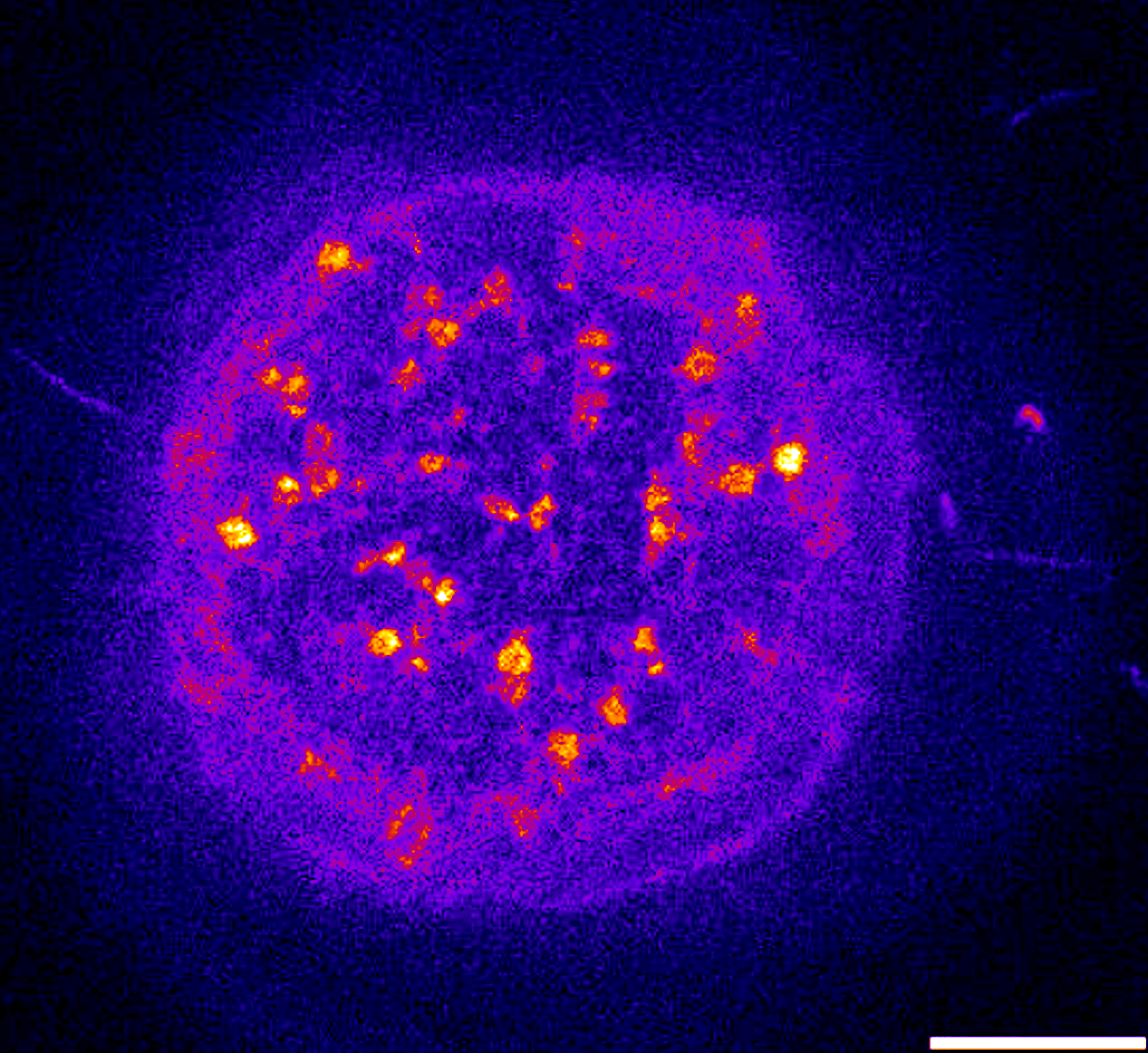
Immune cells can sense their surroundings not only chemically but also physically, by touch. A research team from Brain City Berlin and other institutions has demonstrated this for two key cell types of the immune system: first for T cells, and now for B cells. The findings on B-cell activation were published in early August 2026 in the journal Advanced Science.
B cells: tiny guardians with a sense of touch
B cells are among the immune system’s defense cells. When they encounter foreign pathogens, they produce antibodies. In medical cell therapy, they are specifically activated to produce certain therapeutic agents or to help the immune system fight cancer and autoimmune diseases.
Until now, it was not known that B cells can also respond to mechanical stimuli. “They respond to mechanical stimuli, much like a person who doesn’t just hear but also feels,” explains Prof. Enrico Klotzsch, head of the study and a scientist at the Hereon Institute of Active Polymers and the Berlin Institute of Health at Charité (BIH). “With this discovery, we have decoded a previously little-noticed communication pathway between cells and their environment.”
Nanopores as the key
To make this mechanism visible, the researchers placed the B cells on specially produced surfaces made of anodized aluminum oxide: a biocompatible ceramic whose surface is covered with tiny holes using an electrochemical etching process. These nanopores have a diameter of 250 nanometers, making them several hundred times thinner than a human hair.
“Under the microscope, we were able to observe how the cells’ tiny feelers penetrated these nanopores. We also measured which signals were triggered inside the cells,” says Dr. Nozie D. Aghaizu, first author of the study and a scientist at Humboldt-Universität zu Berlin. This allowed the team to trace, step by step, how a mechanical stimulus triggers an immune response.
The study involved Helmholtz-Zentrum Hereon, Humboldt-Universität zu Berlin, the Berlin Institute of Health at Charité (BIH) and the German Center for Neurodegenerative Diseases (DZNE). The majority of the research team worked in Brain City Berlin.
Building on T-cell research
The new study builds on an earlier investigation by the same research team, which had already demonstrated the same mechanism in T cells. T cells do not produce antibodies; instead, they directly attack pathogens and abnormal cells in the body. In both cases, contact with the anodized aluminum oxide triggered an immune response.
Comparing the two studies directly provides new insights: “B-cell activation is weaker and partly follows different signaling pathways than in T cells. In B cells, molecules that respond to mechanical forces appear to be particularly important,” says Klotzsch.
New possibilities for therapy and materials research
The results of both studies open up new perspectives in two areas. First, for immunotherapy, since targeting immune cells through mechanical signals could enable new treatment approaches. Second, for biomaterials research, because the surface structure of materials apparently plays a much greater role in interacting with the immune system than previously assumed.
For Brain City Berlin, the two studies are an example of what can emerge when basic research, clinical research and materials science come together in one place. The close collaboration between Humboldt-Universität, BIH, DZNE and Hereon’s Teltow site made this discovery possible.
Further information: