
- Innovations
- Transfer – Stories
With digital twins and new couplings: how TU Berlin is researching the railways of tomorrow
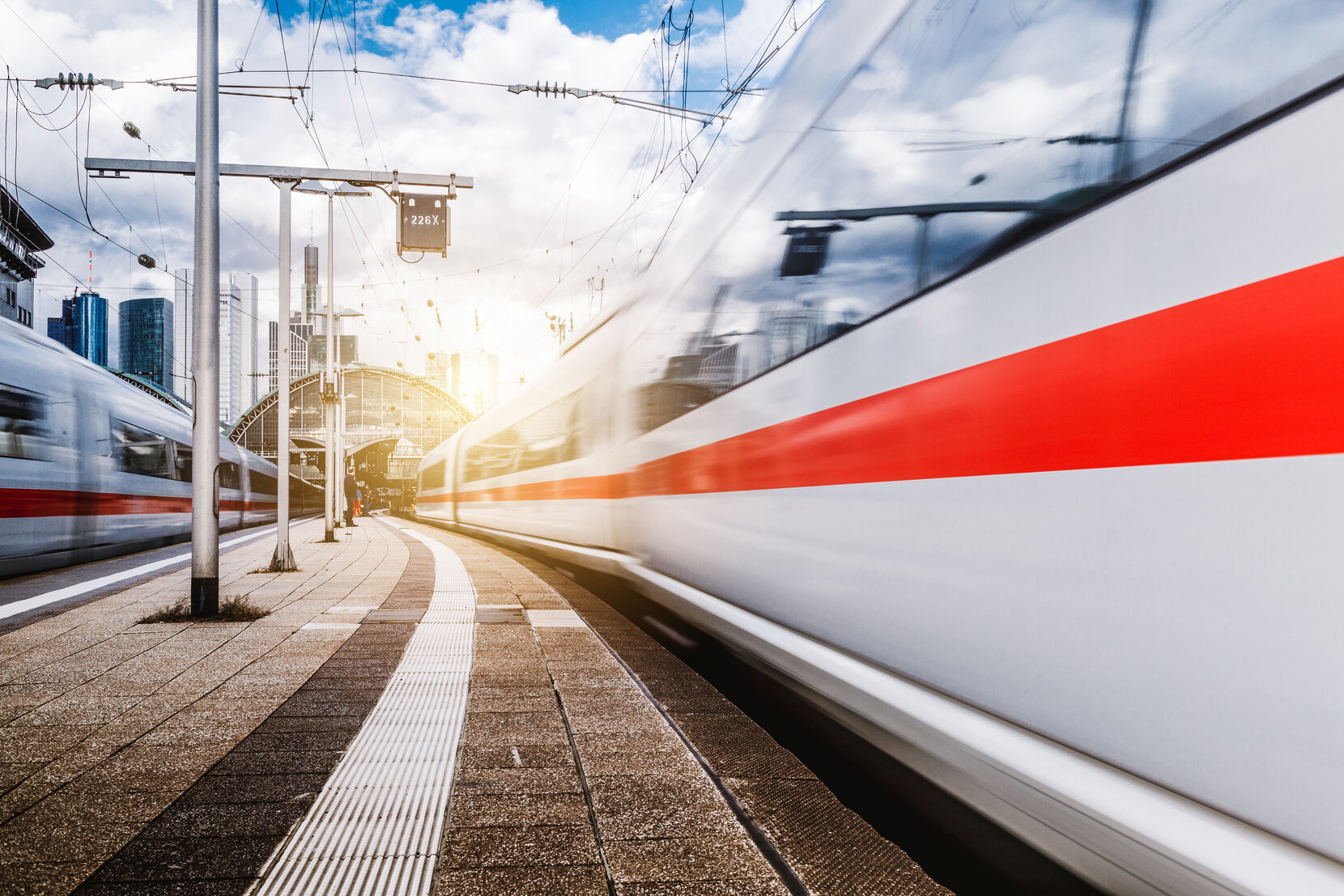
Trains need to become more reliable, faster and more attractive so that more people and goods switch to rail. What is holding this back, and how research can help, is the focus of the Department of Rail Vehicles at Technische Universität Berlin. Since September 2025, the department has been headed by Prof. Dr.-Ing. Beate Bender, who brings industry experience in developing regional trains and now researches vehicle dynamics, maintenance and the future of freight transport in Brain City Berlin.
For Beate Bender, TU Berlin is familiar ground: around 25 years ago, she studied mechanical engineering here, as one of the few women in the field at the time. After completing her doctorate, she spent 13 years in industry, including as technical project manager for the “Talent 2” family of multiple-unit trains at Bombardier. The company received the Berlin-Brandenburg Innovation Award in 2009 for this train family, which is still in service on regional and S-Bahn routes today. She then taught and conducted research at Ruhr University Bochum for twelve years, until she felt drawn back to rail transport. “But at some point, I missed rail vehicles, the technical product I know best!” she says in an interview with TU Berlin. She returned to Berlin as the successor to Prof. Dr.-Ing. Markus Hecht, who headed the department for almost 30 years.
The role of rail in the transport transition
She explains in terms of physics why rail plays a central role in the transition to more sustainable transport: “The rail transport system can use energy much more efficiently on several levels than cars with combustion engines or even electric motors.” An electric train’s drive system achieves an efficiency of up to 90 percent, compared with a maximum of 35 percent for a diesel engine. Trains can also feed electricity back into the overhead line when braking, and the rolling resistance of a steel wheel on a steel rail is significantly lower than that of car tires on asphalt.
One research focus is digital twins: virtual replicas of multiple-unit trains, locomotives and railcars. Together with partners from Aachen, for example, the team has simulated the contact between wheel and rail. The goal is to predict wheel wear and replace wheels in good time, before they damage the rails. This means trains need to go to the workshop for inspection less often. In the MiRTL project, the department is working with university and non-university partners to integrate sensors from different manufacturers in passenger cars so that maintenance can be planned more effectively.
A new coupling for freight transport
The department has helped develop a technology that could transform European freight transport: the Digital Automatic Coupling (DAC). To this day, freight cars are connected by hand using heavy screw couplings. “This is expensive, time-consuming and dangerous, a key problem in freight transport,” says Bender. The DAC connects cars automatically, both mechanically and electrically. However, it will take time before it is in widespread use: existing cars can only be retrofitted to a limited extent, and freight cars remain in service for 40 to 50 years. The team is also studying how much energy is used for shunting in ports, which is currently mostly done with diesel locomotives. Based on these findings, project partners are developing scenarios for switching to battery, hydrogen or overhead-line power.
In Bender’s view, the main reason trains are often late lies with the tracks, not the vehicles: “The problem is the infrastructure, which is at full capacity.” There is a lack of parallel tracks on which faster trains can overtake slower ones.
Young talent and open lectures
Students are also getting involved: in the student-run “TUBahn” project, they are building a locomotive to take part in the European Railway Challenge. Anyone interested in rail transport without being a student can attend the railway engineering seminar that Beate Bender runs together with Prof. Birgit Milius from the Department of Railway Operations and Infrastructure: a lecture series on mobility topics that is open to everyone, both in person and online. In this way, Brain City Berlin is sharing knowledge about the railways of the future beyond the university.
Further information